How ANICA Works
From clinical document to audit-ready codes in 5 stages — powered by Jivica's multi-agent AI engine
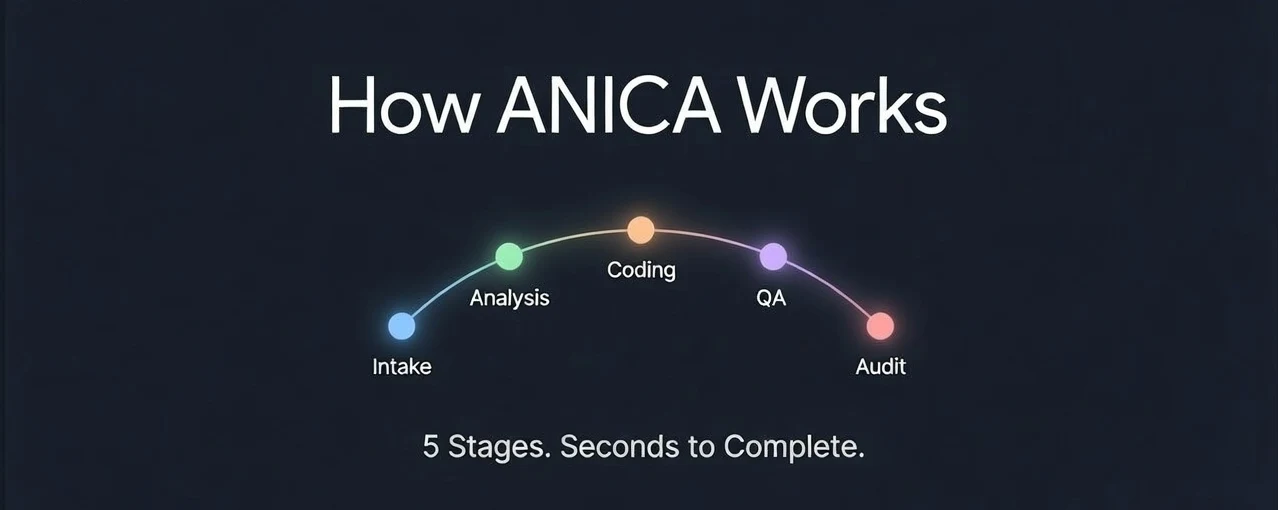
Upload
Clinical documents ingested — PDF, text, scanned images, or HL7
Extract
Parses clinical documents to identify and extract individual progress notes, sections, and provider attestation blocks.
Code
Analyzes clinical text and generates ICD-10-CM code suggestions with confidence scores and evidence citations.
Map & Score
Maps validated ICD-10 codes to HCC categories using V24 and V28 models. Applies hierarchy rules and calculates RAF score impact.
Validate
Final validation checking MEAT criteria, guideline compliance, and RADV readiness. Challenges false positives and recovers missed diagnoses.
Stage Details
Stage 1: Administrative Extraction
~2 secondsAgent: Document Intake
Clinical documents ingested — PDF, text, scanned images, or HL7
Stage 2: Progress Notes Extraction
~5-10 secondsAgent: Clinical Analysis
Parses clinical documents to identify and extract individual progress notes, sections, and provider attestation blocks.
Stage 3: Diagnosis Coding
~10-20 secondsAgent: Code Assignment
Analyzes clinical text and generates ICD-10-CM code suggestions with confidence scores and evidence citations.
Stage 4: HCC Mapping
~3-5 secondsAgent: HCC Mapping
Maps validated ICD-10 codes to HCC categories using V24 and V28 models. Applies hierarchy rules and calculates RAF score impact.
Stage 5: QA Review
~5-10 secondsAgent: Quality Assurance
Final validation checking MEAT criteria, guideline compliance, and RADV readiness. Challenges false positives and recovers missed diagnoses.
Powered by Neuro-Symbolic AI
Every stage of the pipeline combines advanced AI for clinical understanding with a deterministic rule engine that enforces CMS coding rules — zero hallucinations, guaranteed compliance.
Explore the architecture