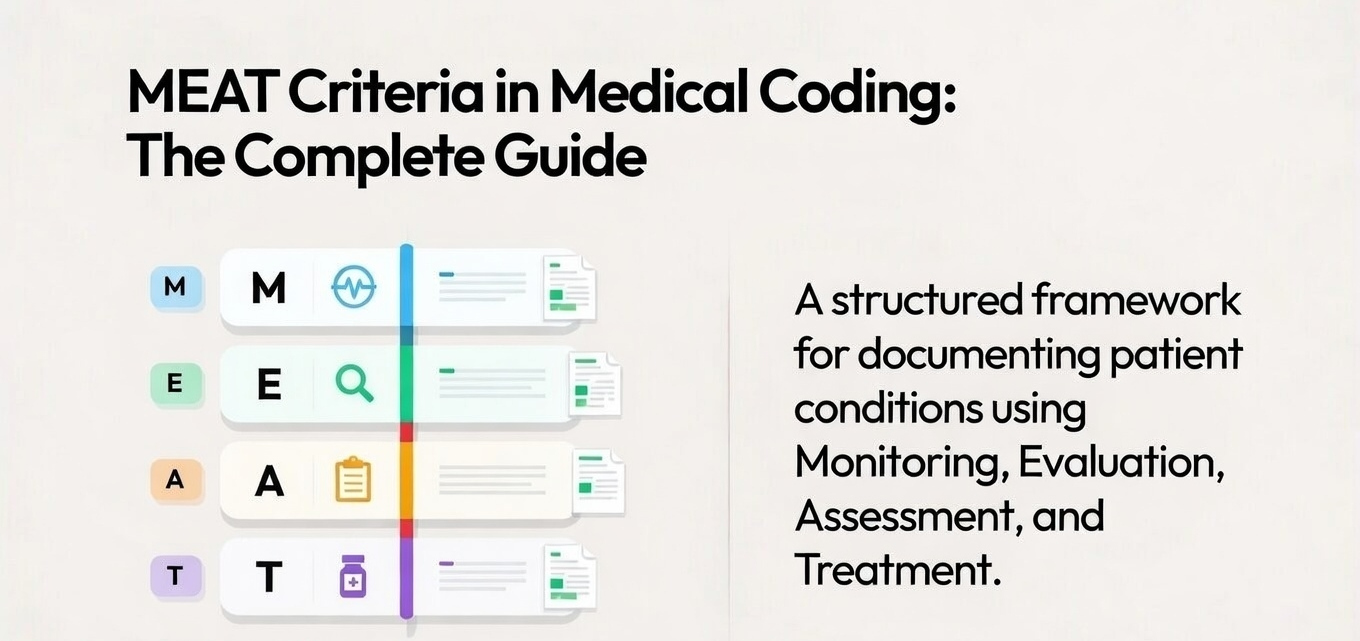
MEAT Criteria in Medical Coding: The Complete Guide
MEAT criteria — Monitor, Evaluate, Assess/Address, and Treat — are the documentation standard that CMS uses to determine whether an HCC-mapped diagnosis is adequately supported for risk adjustment. Every condition submitted to CMS for Medicare Advantage risk adjustment must be backed by clinical documentation showing that a provider actively managed that condition during the encounter. If the documentation does not demonstrate at least one MEAT element, the diagnosis code will not survive a RADV audit and the associated risk adjustment revenue is at risk of recoupment. Understanding MEAT is not optional — it is the single most important documentation concept in risk adjustment coding.
What Are the MEAT Criteria?
MEAT is a documentation framework that defines the minimum clinical evidence required to support a diagnosis code for risk adjustment purposes. The acronym stands for:
- M — Monitor
- E — Evaluate
- A — Assess or Address
- T — Treat
CMS does not require that all four elements be present for every condition at every encounter. A diagnosis is considered adequately supported if the clinical documentation demonstrates at least one MEAT element — evidence that the provider acknowledged and actively managed the condition during the visit. The key principle is that the condition must be more than a passive entry on a problem list; it must be reflected in the clinical narrative as something the provider dealt with during that specific encounter.
The MEAT framework originates from CMS guidance on risk adjustment data validation. The CMS Risk Adjustment Data Validation (RADV) program audits Medicare Advantage organizations to verify that submitted diagnosis codes are supported by medical record documentation. MEAT criteria define what "supported" means in practice. When RADV auditors review a chart, they are looking for MEAT evidence linking each submitted HCC code to clinical activity documented in the encounter note.
Monitor: The First MEAT Element
Monitoring refers to any clinical activity where a provider tracks, observes, or orders tests related to a condition. This element captures the ongoing surveillance that chronic conditions require, even when the condition is stable and no treatment changes are made.
Clinical Examples of Monitoring
- Diabetes (HCC 37, HCC 38): Ordering an HbA1c test to track glycemic control. Reviewing blood glucose logs brought by the patient. Ordering a comprehensive metabolic panel to monitor renal function in a diabetic patient.
- Chronic Kidney Disease (HCC 329, HCC 330): Ordering a GFR and creatinine level. Tracking proteinuria via urine albumin-to-creatinine ratio. Reviewing trends in kidney function over the past 6 months.
- Heart Failure (HCC 224, HCC 225, HCC 226): Ordering a BNP or NT-proBNP to monitor fluid status. Tracking daily weight logs. Reviewing echocardiogram results from a recent study.
- COPD (HCC 280): Ordering pulmonary function tests. Monitoring oxygen saturation levels. Reviewing peak flow measurements.
What Makes Monitoring Documentation Sufficient
The documentation must show that the provider ordered, reviewed, or acknowledged monitoring data specific to the condition. A lab order alone in the EHR is not sufficient if the encounter note does not reference the condition being monitored. The clinical note must connect the monitoring activity to the diagnosis. For example, "Ordered HbA1c to monitor diabetes control" satisfies MEAT, but an HbA1c order buried in a standing lab panel with no mention of diabetes in the note does not.
Evaluate: Clinical Assessment and Workup
Evaluation encompasses any clinical assessment, diagnostic workup, or specialist referral related to a condition. This element captures the provider's cognitive engagement with the condition — the act of considering its status, progression, or differential diagnosis.
Clinical Examples of Evaluation
- Heart Failure (HCC 224, HCC 225, HCC 226): Referring the patient to cardiology for evaluation of worsening dyspnea. Ordering an echocardiogram to evaluate ejection fraction. Assessing functional status using NYHA classification.
- Depression (HCC 155): Administering the PHQ-9 questionnaire to evaluate symptom severity. Assessing suicide risk factors. Evaluating medication efficacy and side effects.
- Diabetes with Complications: Performing a diabetic foot exam. Evaluating for peripheral neuropathy symptoms. Assessing retinal exam findings from ophthalmology.
- COPD (HCC 280): Evaluating a patient's current exacerbation frequency. Assessing whether current bronchodilator therapy is adequate. Reviewing chest imaging to evaluate disease progression.
What Makes Evaluation Documentation Sufficient
Evaluation requires evidence that the provider applied clinical judgment to the condition. This can be a physical exam finding related to the condition, a clinical assessment of the condition's status, a diagnostic test interpretation, or a specialist referral for further evaluation. The documentation must show that the provider thought about the condition — not merely that it exists on the chart.
Assess/Address: Treatment Planning and Clinical Decision-Making
Assessment or addressing refers to the provider's clinical decision-making regarding the condition. This element captures the treatment plan, care plan updates, and documented clinical reasoning about how to manage the condition going forward.
Clinical Examples of Assessment/Addressing
- Diabetes (HCC 37, HCC 38): "HbA1c is 8.2%, up from 7.4% three months ago. Will increase metformin from 1000mg to 1500mg daily and add referral to diabetes educator." This documents the clinical assessment of worsening control and the decision to intensify treatment.
- CHF (HCC 224, HCC 225, HCC 226): "Heart failure with reduced ejection fraction, currently NYHA Class II. EF 35% on recent echo, stable from prior. Continue current diuretic regimen. Patient counseled on sodium restriction and daily weights."
- CKD (HCC 329, HCC 330): "CKD Stage 4, GFR 22. Discussed with patient the trajectory of kidney function and timeline for potential dialysis access planning. Nephrology follow-up in 3 months."
- Depression (HCC 155): "Major depressive disorder, recurrent, moderate. PHQ-9 score 14, improved from 18 last visit. Will continue sertraline 100mg. Patient reports improved sleep and energy. Discussed continuing therapy sessions."
What Makes Assessment Documentation Sufficient
The assessment must show that the provider considered the condition's current state and made a clinical decision — even if that decision is to continue the current plan unchanged. Documentation such as "Diabetes — stable, continue current regimen" satisfies the assessment criterion because it demonstrates the provider evaluated the condition and decided on a management approach. However, simply listing a condition in the assessment section of a note without any commentary does not constitute addressing it.
Treat: Active Interventions and Therapies
Treatment refers to any active intervention — medications prescribed, procedures performed, therapies ordered, or lifestyle modifications formally recommended — that directly addresses the condition.
Clinical Examples of Treatment
- Diabetes (HCC 37, HCC 38): Prescribing metformin 1000mg twice daily. Adjusting insulin dosage. Ordering diabetic shoes. Prescribing continuous glucose monitoring.
- CHF (HCC 224, HCC 225, HCC 226): Prescribing furosemide for fluid management. Adjusting ACE inhibitor dosage. Ordering cardiac rehabilitation. Implanting a defibrillator for reduced EF heart failure.
- COPD (HCC 280): Prescribing albuterol rescue inhaler. Ordering pulmonary rehabilitation. Prescribing supplemental oxygen. Administering pneumococcal and influenza vaccines as part of COPD management.
- CKD (HCC 329, HCC 330): Prescribing phosphate binders. Adjusting antihypertensive medications to protect renal function. Referring for dialysis access placement. Prescribing erythropoietin for anemia of CKD.
What Makes Treatment Documentation Sufficient
Treatment documentation must identify both the intervention and the condition it targets. "Prescribed metformin" alone is insufficient if the note does not link the medication to a specific diagnosis. The strongest treatment documentation states the condition, the intervention, and the clinical rationale: "Type 2 diabetes with HbA1c 8.2% — increase metformin to 1500mg daily to improve glycemic control."
MEAT vs. TAMPER: Alternative Documentation Mnemonics
While MEAT is the most widely recognized documentation framework in risk adjustment, some organizations use an alternative mnemonic called TAMPER:
| Element | MEAT | TAMPER |
|---|---|---|
| T | Treat | Treatment |
| A | Assess/Address | Assessment |
| M | Monitor | Monitor |
| E | Evaluate | Evaluate |
| P | — | Plan |
| R | — | Refer |
TAMPER expands on MEAT by separating "Plan" and "Refer" into distinct elements. In practice, both Plan and Refer are subsets of what MEAT captures under Assess/Address and Evaluate, respectively. CMS does not mandate one mnemonic over the other — both are industry-developed teaching tools. The underlying requirement is the same: the documentation must show that the provider actively managed the condition during the encounter.
Organizations should pick one framework and apply it consistently across their CDI and coding programs. Mixing mnemonics creates confusion among providers and coders without improving compliance.
Common MEAT Failures That Trigger RADV Findings
RADV audits consistently identify the same categories of MEAT documentation failures. Understanding these patterns is critical for prevention.
1. Problem List Carry-Forward Without Encounter Documentation
The most common MEAT failure is a diagnosis that appears on the patient's problem list but is not addressed anywhere in the encounter note. Problem lists are maintained across visits and often contain historical conditions. CMS requires that every condition submitted for risk adjustment be documented as actively managed during a face-to-face encounter in the measurement year. A problem list entry alone is never sufficient.
2. Historical Diagnoses Without Current-Year Support
A condition diagnosed in a prior year must be re-documented with MEAT evidence in the current measurement year to be submitted for risk adjustment. A note that states "History of CHF" without any current clinical activity related to heart failure does not meet MEAT criteria. The provider must demonstrate ongoing management — monitoring labs, evaluating symptoms, assessing stability, or treating the condition.
3. Copy-Forward Notes That Do Not Reflect Current Clinical Status
Electronic health records make it easy to copy previous encounter notes into new visits. When providers copy assessment and plan sections from prior notes without updating them to reflect the current encounter, the documentation may contain MEAT-like language that does not actually describe what happened during the visit. RADV auditors are trained to identify copy-forward patterns, and notes that are identical or near-identical across multiple encounters raise red flags.
4. Missing Diagnostic Specificity
Under V28, MEAT compliance is not just about documenting that a condition was managed — it requires that the documentation supports the specific code submitted. Documenting "diabetes" when the submitted code specifies "Type 2 diabetes mellitus with diabetic chronic kidney disease" requires MEAT evidence for both the diabetes and the kidney disease complication. If the note only addresses diabetes management without mentioning renal involvement, the more specific code is not supported. This specificity requirement has intensified under V28's severity-tiered HCC model.
5. Insufficient Linkage Between Activity and Diagnosis
Ordering a lab test, prescribing a medication, or making a referral does not satisfy MEAT if the documentation does not connect the activity to the specific diagnosis. An HbA1c order satisfies MEAT for diabetes only if the note associates the test with diabetes management. If the note simply lists lab orders without clinical context, auditors cannot infer the connection.
MEAT Documentation by Condition Type
The following table provides MEAT documentation examples for commonly reported HCC conditions:
| Condition | Monitor | Evaluate | Assess/Address | Treat |
|---|---|---|---|---|
| Type 2 Diabetes (HCC 37) | Order HbA1c, review glucose logs | Diabetic foot exam, retinal screening review | "HbA1c 7.8%, at target. Continue current regimen." | Prescribe metformin 1000mg BID |
| CHF (HCC 224–226) | Order BNP, track daily weights | Assess NYHA class, review echo results | "HFrEF stable, EF 30%. No medication changes." | Prescribe furosemide 40mg daily |
| CKD Stage 4 (HCC 329) | Order GFR, creatinine, urine albumin | Assess kidney function trajectory | "GFR 24, declining. Discuss dialysis planning." | Prescribe sevelamer for phosphorus control |
| COPD (HCC 280) | Order PFTs, monitor O2 saturation | Assess exacerbation frequency | "COPD stable, 1 exacerbation this year." | Prescribe tiotropium inhaler |
| Major Depression (HCC 155) | Administer PHQ-9 | Assess suicidal ideation, review therapy progress | "PHQ-9 score 12, moderate. Continue SSRI." | Prescribe sertraline 100mg daily |
| Macular Degeneration (HCC 310) | Review OCT imaging | Assess visual acuity changes | "Wet AMD, stable on current injection schedule." | Administer intravitreal anti-VEGF injection |
This table illustrates that any single column — one MEAT element — is sufficient to support the diagnosis for risk adjustment. However, documenting multiple elements strengthens the submission and provides a more defensible audit trail.
V28 Impact on MEAT Requirements
The transition to CMS-HCC V28 has materially changed how MEAT criteria apply in practice. While the MEAT framework itself is unchanged, V28's structural changes increase the documentation burden.
Higher Specificity Demands
V28 introduced severity-tiered HCC categories for conditions that were previously single-tier. Heart failure, for example, now maps to different HCCs depending on whether the ejection fraction is reduced, preserved, or unspecified. MEAT documentation must support not just that heart failure was managed, but that the specific type of heart failure corresponding to the submitted HCC code was addressed.
If a provider documents general heart failure management but does not reference ejection fraction findings, the documentation may support a lower-severity HCC but not the higher-weighted category. The difference in RAF score between HCC tiers can be substantial, making specificity a direct revenue driver.
Dropped Conditions Require Documentation Pivots
V28 removed several conditions from risk adjustment, including morbid obesity as a standalone HCC and lower-severity depression codes. Organizations that previously captured these conditions must redirect their MEAT documentation efforts toward conditions that remain or are newly risk-adjustable. Providers need education on which conditions still require MEAT-compliant documentation and which no longer generate risk adjustment value.
Severity Documentation Is Now a MEAT Requirement
Under V28, documenting that a condition exists and is being managed is necessary but may not be sufficient if the submitted code implies a severity level. For CKD, only stages 4 and 5 are risk-adjustable — so MEAT documentation must include the specific stage, supported by GFR values or equivalent clinical evidence. For dementia, MEAT must address whether behavioral disturbances or complications are present if the submitted code reflects a higher-severity tier.
How AI Automates MEAT Validation
Manual MEAT compliance review is labor-intensive. A coder must read through each encounter note, identify every submitted diagnosis, locate the corresponding MEAT evidence, and assess whether the documentation is sufficient. For organizations processing tens of thousands of charts, this creates a bottleneck that delays submissions and introduces inconsistency.
AI-powered coding platforms transform MEAT validation from a manual review process into an automated, scalable operation.
NLP Evidence Extraction
Natural language processing extracts MEAT evidence from unstructured clinical notes in real time. The AI reads the encounter narrative — including history of present illness, review of systems, physical exam, assessment, and plan sections — and identifies clinical activities that correspond to each MEAT element for every documented condition.
Per-Diagnosis MEAT Compliance Scoring
Rather than a binary pass/fail, AI systems can score each diagnosis on the strength of its MEAT support. A condition with documented treatment, monitoring labs, and a detailed assessment receives a higher compliance score than one supported by a single brief mention. This scoring allows coding teams to prioritize their review efforts on diagnoses with borderline MEAT support.
ANICA, Jivica's AI medical coding engine, performs per-diagnosis MEAT compliance scoring using its multi-agent architecture. Each of ANICA's 9 specialized AI agents handles a different aspect of the coding workflow, including dedicated agents for clinical NLP, evidence extraction, and MEAT validation. The result is a compliance score for every diagnosis on every chart, computed in seconds rather than minutes.
Missing MEAT Element Flagging
When the AI detects a submitted diagnosis without adequate MEAT support, it generates a query for the coding team or provider. These queries are specific: instead of a generic "documentation insufficient" alert, the system identifies exactly which MEAT element is missing and what documentation would resolve the gap. For example: "HCC 37 (Type 2 Diabetes) — Treatment and Monitor documented, but no Assessment found in encounter note. Recommend provider add current status and plan."
Evidence Trail Generation
For every submitted code, AI platforms generate an evidence trail — a structured record linking the diagnosis code to the specific sentences, lab values, and clinical activities in the note that support it. These evidence trails serve as pre-built audit defense documentation. When a RADV auditor requests supporting evidence for a submitted HCC code, the organization can provide a clear, structured MEAT evidence map instead of requiring the auditor to search through unstructured notes.
ANICA's evidence trails are integrated into its RADV readiness scoring, which incorporates MEAT validation, code accuracy, and documentation specificity into a single per-chart audit risk score.
Best Practices for MEAT Compliance
Provider Education
Providers are the source of MEAT documentation. CDI programs should educate physicians on the MEAT framework with condition-specific guidance — not abstract training on documentation concepts. A cardiologist needs to know that documenting ejection fraction type is essential for heart failure HCC capture under V28. An internist managing a panel of diabetic patients needs to understand that a problem list entry alone does not satisfy MEAT.
CDI Program Alignment
Clinical documentation improvement specialists should use MEAT as their primary review framework. CDI queries should be structured around specific MEAT gaps: "The note documents monitoring (HbA1c ordered) but does not include an assessment of the diabetes. Can you add your clinical assessment of the patient's current diabetes status and management plan?"
Pre-Submission Validation
Every HCC code should pass a MEAT validation check before it is submitted for risk adjustment. This is the single most effective control for preventing RADV findings. Organizations that rely on post-submission auditing to catch MEAT failures are accepting unnecessary risk and remediation costs.
Condition-Specific Templates
Develop EHR documentation templates that prompt providers for MEAT elements when managing common HCC conditions. A diabetes management template, for example, can include fields for monitoring data (HbA1c, glucose trends), evaluation (foot exam, eye exam), assessment (current status, complications), and treatment (medications, dosage changes). These templates reduce documentation burden while increasing MEAT compliance.
Annual MEAT Audits
Conduct internal MEAT compliance audits at least annually, sampling charts across provider types and common HCC conditions. Use audit findings to identify systematic documentation gaps and target provider education. Track MEAT compliance rates over time as a quality metric.
Frequently Asked Questions
Does every MEAT element need to be documented for each condition?
No. CMS requires documentation of at least one MEAT element per condition per encounter to support a risk adjustment submission. A condition where the provider monitored labs, evaluated symptoms, assessed the treatment plan, and prescribed medication has stronger documentation than one with a single element — but a single element is sufficient for compliance. The practical recommendation is to document as many elements as naturally apply during the encounter, without adding unnecessary verbiage.
Can a condition on the problem list alone satisfy MEAT criteria?
No. A problem list entry is not clinical documentation of active management. The condition must be referenced in the body of the encounter note with evidence that the provider monitored, evaluated, assessed, or treated it during the visit. This is one of the most frequent misunderstandings in risk adjustment coding and one of the most common causes of RADV audit failures.
How often must MEAT be documented for a chronic condition?
CMS requires that every condition submitted for risk adjustment be supported by MEAT documentation from a face-to-face encounter during the applicable measurement year. For Medicare Advantage, the measurement year is the calendar year (January 1 through December 31) corresponding to the payment year data submission. A chronic condition must have at least one encounter with MEAT documentation each year it is submitted, regardless of how long the condition has been present.
What is the difference between MEAT for risk adjustment and general E/M documentation?
E/M documentation supports the level of service billed for an encounter. MEAT documentation supports the specific diagnosis codes submitted for risk adjustment. They are related but distinct requirements. An encounter can have excellent E/M documentation supporting a high-complexity visit while failing MEAT criteria for a specific chronic condition if that condition was not addressed in the note. Conversely, a brief note that mentions monitoring a patient's HbA1c may satisfy MEAT for diabetes without supporting a high-level E/M code.
Does MEAT apply to acute conditions or only chronic conditions?
MEAT applies to any condition submitted for HCC risk adjustment, whether acute or chronic. Acute conditions such as a major infection, stroke, or acute myocardial infarction require MEAT evidence just like chronic conditions. The difference is practical: acute conditions are typically well-documented because they are the primary reason for the encounter, while chronic conditions are more likely to be under-documented because they are managed alongside other complaints.
Conclusion
MEAT criteria are the foundation of defensible risk adjustment coding. Every HCC submission depends on clinical documentation that demonstrates active provider management — not problem list entries, not copy-forward notes, not historical diagnoses without current-year evidence. As V28's severity-tiered model raises documentation specificity requirements and RADV audits increase in scope, MEAT compliance is more consequential than ever.
Organizations that automate MEAT validation can process higher volumes with greater consistency, catch documentation gaps before submission, and build audit-ready evidence trails for every code. ANICA is purpose-built for this workflow — with per-diagnosis MEAT compliance scoring, automated evidence extraction, missing element flagging, and RADV readiness scoring integrated into every chart. Schedule a demo to see how ANICA validates MEAT compliance across your risk adjustment portfolio.
References: CMS Risk Adjustment Data Validation (RADV), CMS 2024 Rate Announcement and Final Call Letter, AHIMA Risk Adjustment Documentation and Coding Guidelines, AAPC Risk Adjustment Coding Resources, CMS ICD-10-CM Official Guidelines for Coding and Reporting.