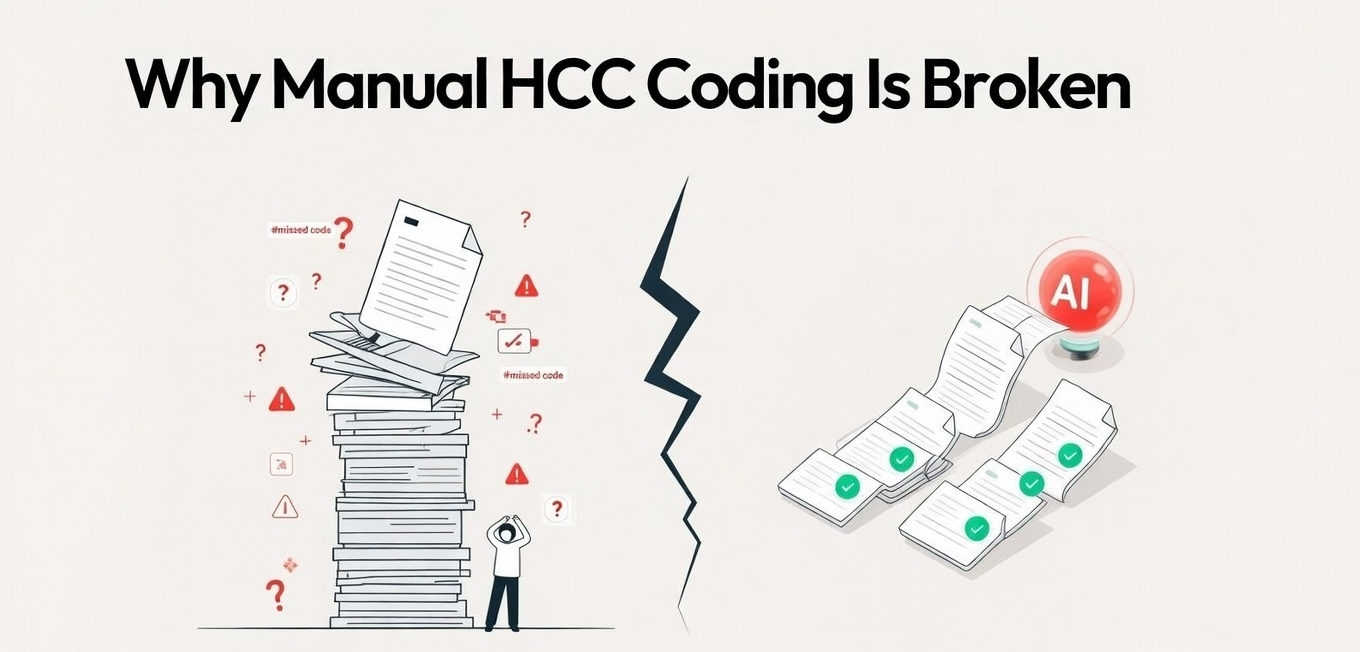
Why Manual HCC Coding Is Broken
Manual HCC coding is broken because it relies on a shrinking workforce to perform an increasingly complex task at a scale that human processes cannot sustain. The average manual coder takes 10-20 minutes per chart, achieves 60-85% accuracy, and costs $55,000-$75,000 in base salary alone -- yet Medicare Advantage plans need millions of charts coded accurately every measurement year. The result is billions of dollars in missed risk-adjusted revenue, mounting RADV audit exposure, and an operational model that deteriorates further with every passing year. The manual coding paradigm does not have a staffing solution. It has a structural problem that only technology can address.
The Scale Problem: Millions of Charts, Not Enough Hands
The fundamental arithmetic of manual HCC coding does not work. CMS reported over 33.8 million Medicare Advantage enrollees in 2025, according to the CMS Medicare Advantage/Part D Contract and Enrollment Data. Each enrollee generates multiple clinical encounters per measurement year that require risk adjustment coding. For a mid-sized Medicare Advantage plan with 200,000 members, annual chart review volumes routinely exceed 400,000-600,000 charts when factoring in retrospective reviews, prospective coding, and chart chase activities.
At 10-20 minutes per chart, a single full-time coder can process approximately 10,000-15,000 charts per year. A plan with 500,000 charts to review needs 35-50 dedicated coders working at full productivity for an entire year. That is just to get through the volume -- it says nothing about accuracy, quality assurance, or the inevitable rework when errors are discovered during audits.
The math becomes impossible when you layer in the reality that:
- Chart complexity is increasing. V28 introduced 115 HCC categories with severity tiering, requiring coders to evaluate more clinical nuances per chart.
- Volume is growing. Medicare Advantage enrollment has grown at roughly 8% annually for the past decade, and CMS projects continued growth through 2030.
- Retrospective reviews are expanding. Organizations are conducting more retrospective chart reviews to capture missed HCCs, adding to an already overwhelming workload.
No hiring plan can solve a problem that compounds faster than the workforce can grow.
The Accuracy Crisis: 60-85% Is Not Good Enough
Human coder accuracy in HCC coding ranges from 60% to 85%, depending on chart complexity, coder experience, and the specific coding task, according to AHIMA benchmarking studies and AAPC workforce surveys. While 85% accuracy might sound acceptable in isolation, in risk adjustment coding it represents a catastrophic revenue gap.
What Inaccuracy Actually Costs
Every missed HCC code directly reduces a patient's Risk Adjustment Factor (RAF) score, which determines the capitated payment the plan receives for that enrollee for the entire measurement year. A single missed HCC can reduce an individual's annual RAF-driven payment by $800-$3,000 or more, depending on the condition's coefficient weight.
Scale that across a population:
| Scenario | Metric |
|---|---|
| Plan membership | 200,000 enrollees |
| Charts requiring HCC coding | 500,000 per year |
| Missed HCC rate at 80% accuracy | 20% of valid HCCs uncaptured |
| Average revenue per missed HCC | $1,200 |
| Estimated annual revenue loss | $12 million - $30 million |
These are not hypothetical figures. McKinsey's 2024 analysis of healthcare AI adoption estimated that coding inaccuracies cost health plans 1-3% of risk-adjusted revenue annually. For a plan receiving $2 billion in annual risk-adjusted payments, that translates to $20-$60 million in revenue leakage attributable to coding errors alone.
Overcoding Is Equally Dangerous
Accuracy problems cut both ways. Overcoding -- assigning HCC codes without adequate clinical documentation -- exposes organizations to RADV audit clawbacks and False Claims Act liability. Manual coders under productivity pressure may assign codes based on incomplete evidence, and those codes become audit targets. The financial penalty for overcoding can dwarf the original revenue gain: CMS RADV extrapolation methodology means a finding on a sample of charts can be extrapolated to the entire population, resulting in repayment demands of $2 million to $10 million or more.
Manual coding cannot consistently thread the needle between capturing every valid HCC and avoiding unsupported codes. The cognitive load is too high, the time pressure too intense, and the feedback loops too slow.
The Coder Shortage: A Workforce in Crisis
The medical coding profession is facing a structural workforce shortage that shows no signs of reversing. AHIMA has consistently reported a nationwide shortage of qualified medical coders, with estimates suggesting the industry is short 30% or more of the coders it needs. The problem is driven by several converging factors:
- Aging workforce. A significant portion of the certified coding workforce is approaching retirement age. AAPC's 2025 membership demographics indicate that the median age of certified coders continues to rise, with limited pipeline replacement from younger professionals.
- High turnover. Coding is mentally demanding, repetitive work with intense productivity requirements. Industry surveys report annual turnover rates of 25-30% for production coding roles, driven by burnout, wage competition, and the availability of remote work alternatives.
- Long training cycles. Becoming a proficient HCC coder requires AAPC or AHIMA certification (CPC, CRC, or CCS credentials), which takes 6-12 months of study, followed by 1-2 years of supervised production coding to reach full proficiency. The total time from entry to full productivity is 2-3 years -- and many trainees leave the field before reaching that milestone.
- Competition for talent. The same analytical skills that make good coders are in demand across healthcare administration, data analytics, and health IT roles -- many of which offer higher compensation and less repetitive work.
The Wage Spiral
The shortage creates a wage spiral that compounds the cost problem. As qualified coders become scarcer, organizations must offer higher salaries, signing bonuses, and remote work flexibility to attract and retain talent. The Bureau of Labor Statistics reports steady wage growth for medical records specialists, and specialized risk adjustment coders command even higher premiums.
For organizations that cannot compete on compensation -- particularly smaller plans and rural provider groups -- the alternative is outsourcing to third-party coding vendors at rates of $4-$8 per chart, or offshore coding operations that introduce their own accuracy and compliance challenges.
The coder shortage is not a temporary labor market fluctuation. It is a permanent structural constraint that makes the manual coding model progressively less viable each year.
RADV Audit Exposure: Manual Processes Cannot Produce Audit-Ready Documentation
CMS Risk Adjustment Data Validation (RADV) audits are the enforcement mechanism for HCC coding integrity. Auditors review a sample of charts to verify that every submitted HCC code is supported by clinical documentation meeting MEAT criteria -- the provider must have Monitored, Evaluated, Assessed/Addressed, or Treated the condition during the documented encounter.
Manual coding workflows are structurally weak against RADV scrutiny for several reasons:
No Systematic Evidence Trails
When a human coder assigns an HCC code, the evidence trail is typically a code on a claim form -- not a linked, auditable connection between the specific clinical documentation and the code. During RADV audit, the organization must retrospectively locate and present the clinical note that supports each questioned code. This chart chase process is expensive, time-consuming, and frequently unsuccessful. Charts may be incomplete, documentation may be ambiguous, and the original coder's reasoning is rarely recorded.
Inconsistent MEAT Compliance
Manual coders are trained on MEAT criteria, but consistent application under productivity pressure is another matter. A coder processing 30-40 charts per day may not meticulously verify that every condition meets all MEAT requirements, particularly for conditions that appear well-documented on initial review but lack specific treatment or monitoring evidence. These marginal cases are precisely what RADV auditors target.
Extrapolation Amplifies Every Error
CMS finalized its RADV extrapolation methodology in the January 2025 final rule, confirming that audit findings on a sample of charts will be extrapolated to the full Medicare Advantage contract population. This means a 5% error rate found in a 200-chart audit sample does not result in repayment for 10 charts -- it results in repayment calculated as if that 5% error rate applies to every enrollee in the plan. For large plans, the financial exposure from extrapolated RADV findings runs into tens of millions of dollars.
Manual coding processes cannot produce the consistent, documented, evidence-linked coding that RADV extrapolation demands. The risk is not theoretical -- it is an actuarial certainty that grows with every chart coded without a systematic evidence trail.
V28 Complexity: Too Many Rules for Manual Processes
The CMS-HCC V28 model, which reached 100% implementation in payment year 2026 with no remaining V24 blending, represents the most complex risk adjustment model ever deployed. As detailed in the 2024 Rate Announcement, V28 expanded the HCC category set from 86 to 115 categories while simultaneously reducing the number of accepted ICD-10-CM codes from 9,797 to 7,770.
This combination -- more categories, fewer accepted codes, and new severity hierarchies -- creates a coding environment that exceeds the reliable capacity of manual processes:
| V28 Complexity Factor | Impact on Manual Coding |
|---|---|
| 115 HCC categories (vs. 86 in V24) | Coders must learn and apply 34% more category distinctions |
| 7,770 accepted ICD-10 codes (vs. 9,797) | 2,027 previously valid codes no longer map to HCCs -- coders must unlearn old habits |
| Severity tiering (heart failure, dementia, etc.) | Documentation specificity determines payment tier -- generic coding loses revenue |
| Dual community/institutional models | Different coefficients apply based on enrollment status -- coders must track both |
| V24/V28 transition lookback | Retrospective analyses require dual-model comparison for financial reconciliation |
Manual coders trained on V24 logic must now simultaneously unlearn codes that no longer count, learn new severity distinctions, and apply different rules depending on the enrollee's institutional status. The cognitive load is enormous, and the error rate under V28 is higher than under V24 precisely because the model demands a level of precision and currency that human memory and manual reference lookups cannot reliably deliver.
Organizations that have not invested in technology-assisted V28 coding are already seeing the impact in lower RAF scores and missed revenue from newly available severity-tiered categories.
The Cost Burden: Manual Coding Economics Are Unsustainable
The fully loaded cost of a manual HCC coding operation extends far beyond coder salaries. When you account for every cost layer, the economics of manual coding are deteriorating year over year.
Fully Loaded Cost Structure
| Cost Component | Annual Cost per Coder |
|---|---|
| Base salary (CRC/CPC certified) | $55,000 - $75,000 |
| Benefits and payroll taxes (30%) | $16,500 - $22,500 |
| Training and CE (certification, V28 updates) | $2,000 - $4,000 |
| Encoder software and technology | $3,000 - $5,000 |
| Management and supervision (allocated) | $5,000 - $8,000 |
| QA audit and rework time (15% of production) | $8,250 - $11,250 |
| Recruitment and turnover costs (amortized) | $4,000 - $7,000 |
| Total fully loaded cost per coder | $93,750 - $132,750 |
At the midpoint of $113,000 per fully loaded coder and an annual output of 12,000 charts, the effective cost per chart is approximately $9.42. Even blending in lower-cost outsourced coding brings the average to $4.00-$6.00 per chart -- a number that increases every year as wages rise and the coder shortage intensifies.
The Rework Multiplier
Manual coding errors are not free to fix. Every inaccurate code that is caught during internal QA, payer audit, or RADV review must be investigated, corrected, and resubmitted. The cost of reworking a coded chart is typically 2-3x the cost of coding it correctly the first time, because rework requires a senior coder to review the original coder's work, locate the relevant documentation, determine the correct code, and process the correction through the billing system.
For an organization with a 15-20% error rate on initial coding, the rework burden adds 30-60% to the effective cost of coding -- a hidden tax that compounds the already unsustainable economics of manual processes.
Error Propagation: One Missed HCC Compounds for 12 Months
HCC coding operates on an annual measurement cycle. Risk adjustment factor scores are calculated based on diagnoses documented and coded during the measurement year, and those scores determine capitated payments for the following payment year. This annual cycle means that a missed HCC code does not just cost the organization revenue for a single encounter -- it reduces the patient's RAF score for the entire measurement year, affecting 12 months of capitated payments.
How a Single Error Cascades
Consider a patient with documented Type 2 diabetes with chronic kidney disease (CKD Stage 4). Under V28, the diabetes and CKD Stage 4 map to separate HCCs with significant payment weights. If a coder captures the diabetes but misses the CKD Stage 4 -- perhaps because the documentation requires review of lab values rather than a simple problem list scan -- the missed HCC reduces that patient's RAF score for the full year.
- RAF impact of missed CKD Stage 4 HCC: Approximately 0.20 - 0.35 RAF score reduction
- Revenue impact per patient: $1,800 - $3,200 in reduced annual capitation
- If this pattern repeats across 500 patients: $900,000 - $1,600,000 in annual revenue loss
The annual measurement cycle also means there is no second chance for most encounters. If a condition is not coded during the encounter where it was documented, capturing it later requires a retrospective chart review -- an expensive, labor-intensive process that many organizations cannot execute at scale.
This error propagation dynamic makes first-pass accuracy the single most important metric in HCC coding. Manual processes that achieve 60-85% first-pass accuracy are structurally incapable of maximizing risk-adjusted revenue.
The Solution: AI-Powered HCC Coding
The structural problems with manual HCC coding -- scale limitations, accuracy gaps, workforce shortages, RADV exposure, V28 complexity, unsustainable costs, and error propagation -- are not problems that can be solved by hiring more coders, improving training, or implementing better QA processes. They are systemic failures of a manual paradigm applied to a task that has outgrown human capacity.
AI-powered HCC coding addresses every dimension of the problem simultaneously.
Speed That Matches the Scale
ANICA, Jivica's AI medical coding engine, processes a clinical chart in 5-15 seconds -- compared to 10-20 minutes for a manual coder. At that speed, a single ANICA deployment can process over 10,000 charts per day, replacing the throughput of 30-50 human coders. The scale problem disappears because AI processing capacity is virtually unlimited and does not degrade with volume.
Accuracy That Protects Revenue
ANICA achieves 92.6% accuracy across ICD-10, HCC, and E/M coding categories. This is not a theoretical benchmark -- it is measured accuracy on production clinical documents across multiple code types. The accuracy improvement from 75% (manual average) to 92.6% (ANICA) translates directly to captured revenue that manual processes leave on the table.
Architecture Built for Complexity
ANICA deploys 9 specialized AI agents and 24 MCP (Model Context Protocol) tools, each handling a specific aspect of the coding workflow: clinical NLP, evidence extraction, code assignment, MEAT validation, RADV readiness scoring, and dual-model V24/V28 processing. This multi-agent architecture means V28 complexity is distributed across specialized components rather than loaded onto a single human coder trying to hold 115 HCC categories in working memory.
Audit-Ready by Default
Every code ANICA assigns includes a complete evidence trail linking the HCC to specific clinical documentation, MEAT criteria validation, and a RADV readiness score. This evidence trail is generated automatically during coding -- not reconstructed months later during an audit response. Organizations using ANICA can respond to RADV audit requests with pre-built documentation packages rather than scrambling through chart chase operations.
Data Security by Design
For organizations processing clinical documents through AI systems, data security and HIPAA compliance are non-negotiable. Jivica's DelPHI de-identification platform ensures that protected health information is handled in compliance with HIPAA Safe Harbor and Expert Determination methods before any AI processing occurs, providing a complete chain of custody for sensitive clinical data.
Frequently Asked Questions
Can manual HCC coding accuracy be improved with better training?
Training improves individual coder performance, but it cannot overcome the structural limitations of manual processes. Even the best-trained coder is subject to fatigue, distraction, and cognitive overload when processing 30-40 complex charts per day. AHIMA and AAPC continuing education programs raise the floor of coder competency, but they do not change the fundamental throughput-accuracy tradeoff that manual coding imposes. Organizations that invest heavily in training typically see accuracy improvements of 3-5 percentage points -- meaningful, but insufficient to close the gap with AI-assisted coding at 92.6%.
How does AI coding handle ambiguous clinical documentation?
AI coding platforms flag ambiguous documentation for human review rather than guessing. ANICA's multi-agent architecture includes confidence scoring on every code assignment. When clinical evidence for a condition is ambiguous or incomplete, the system routes the chart to a human coder for review rather than assigning an unsupported code. This hybrid workflow -- AI for clear cases, human review for ambiguous ones -- produces higher accuracy than either approach alone and ensures that no code is submitted without adequate evidence.
What happens to human coders when AI is deployed?
AI coding does not eliminate the need for human coders -- it transforms their role. Instead of production coding (reading every chart and assigning every code), coders transition to exception review, quality oversight, clinical documentation improvement (CDI), and audit response. These are higher-value, less repetitive roles that leverage coder expertise more effectively and reduce the burnout that drives the industry's 25-30% turnover rate. Most organizations that deploy AI coding retain 60-70% of their coding staff in restructured roles.
Is AI coding accurate enough for RADV audits?
ANICA's 92.6% accuracy rate exceeds manual coder performance, but accuracy alone does not determine RADV readiness. What distinguishes AI-assisted coding in audit scenarios is the systematic evidence trail. Every ANICA-assigned code links to specific clinical documentation with MEAT criteria mapping and a RADV readiness score. This structured evidence package is exactly what CMS auditors evaluate -- and it is generated automatically for every chart, not reconstructed after the fact for a sample of audited charts.
Conclusion: The Manual Model Has Reached Its Limit
Manual HCC coding was viable when Medicare Advantage enrollment was smaller, the HCC model was simpler, and the coder workforce was growing. None of those conditions exist in 2026. Enrollment has surpassed 33 million and continues growing. V28 is the most complex risk adjustment model ever deployed. The coder shortage is structural and worsening. And CMS RADV extrapolation has made coding errors an existential financial risk.
Organizations that continue to rely entirely on manual coding are not just leaving revenue on the table -- they are accumulating audit exposure, burning out their workforce, and falling further behind on the V28 learning curve with every measurement cycle that passes.
The path forward requires AI-powered coding that can match the scale of the problem, deliver the accuracy the revenue model demands, and produce the audit-ready evidence trails that CMS requires. ANICA was built for exactly this purpose -- 9 AI agents, 24 MCP tools, 92.6% accuracy, 5-15 seconds per chart, and full V24/V28 dual-model support with RADV readiness scoring on every coded chart.
Schedule a demo to see how ANICA handles your HCC coding workflow, or explore the ANICA platform page for a detailed look at the multi-agent architecture.
References: CMS Medicare Advantage Enrollment Data, CMS 2024 Rate Announcement and Final Call Letter, CMS RADV Audit Methodology, Bureau of Labor Statistics -- Medical Records Specialists, AHIMA Workforce Studies, AAPC Salary Survey and Certification Resources.