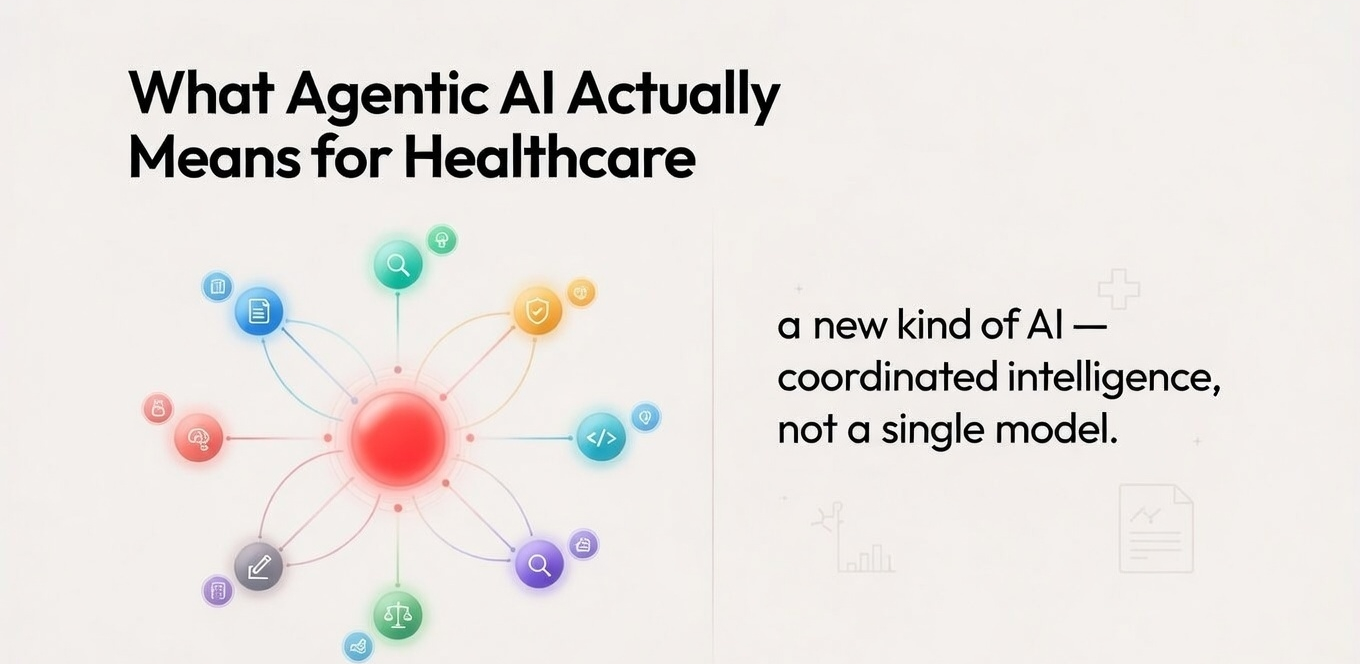
What Agentic AI Actually Means for Healthcare
Agentic AI refers to artificial intelligence systems composed of autonomous agents that can plan, reason, use tools, retain memory across tasks, and self-correct — rather than simply predicting the next token in a sequence. In healthcare, this distinction is not academic. Clinical documentation is complex, unstructured, and laden with context that demands judgment, not just pattern matching. Agentic AI systems coordinate multiple specialized agents, each responsible for a distinct cognitive task, to produce outputs that are accurate, auditable, and defensible under regulatory scrutiny. This is the architecture that healthcare's hardest problems — medical coding, RADV audit preparation, risk adjustment — actually require.
The AI Maturity Spectrum: From Rules to Agents
Not all AI is created equal. The term "artificial intelligence" spans a wide range of capabilities, from simple rule engines to autonomous multi-agent systems. Understanding where agentic AI sits on this spectrum is essential for evaluating any AI solution in healthcare.
| Generation | Approach | How It Works | Healthcare Example | Limitations |
|---|---|---|---|---|
| Gen 1: Rule-Based Systems | If-then logic | Human-authored rules map inputs to outputs | Encoder software with ICD-10 lookup tables | Cannot handle ambiguity or unstructured text |
| Gen 2: Statistical ML | Supervised learning | Models trained on labeled data to classify inputs | NLP models identifying diagnosis mentions in notes | Requires massive labeled datasets; brittle to distribution shifts |
| Gen 3: Deep Learning | Neural networks | Multi-layer networks learn complex representations | Image classification in radiology; pathology slide analysis | Black-box outputs; no reasoning chain; limited to single tasks |
| Gen 4: Large Language Models | Transformer architectures | Predict next tokens based on vast training corpora | Clinical text summarization; draft coding suggestions | Hallucination risk; no self-validation; single-pass reasoning |
| Gen 5: Agentic AI | Multi-agent orchestration | Autonomous agents plan, reason, use tools, validate, and iterate | End-to-end medical coding with evidence extraction, validation, and audit scoring | Requires careful architecture; higher compute cost; newer paradigm |
Each generation builds on the one before it. Rule-based systems are deterministic but inflexible. Statistical ML handles variability but requires enormous labeled training sets. Deep learning captures complex patterns but produces opaque outputs. Large language models understand and generate natural language at scale but are fundamentally single-pass systems — they produce an answer and move on, with no mechanism to check their own work.
Agentic AI is the first generation that closes the loop. It does not just produce an output — it evaluates that output, consults external tools and knowledge sources, identifies gaps, and iterates until the result meets defined quality thresholds. For a domain like healthcare, where a wrong answer can trigger audit liability, revenue loss, or patient harm, this self-correcting architecture is not a luxury. It is a structural requirement.
What Makes an AI System Truly "Agentic"
The term "agentic" has become a marketing buzzword. Vendors append it to products that are, in reality, single-model LLM wrappers with a prompt template. To evaluate claims rigorously, healthcare leaders need a clear definition of what agentic actually means at an architectural level.
An AI system qualifies as agentic when it exhibits these six properties:
-
Autonomy — Agents operate independently within defined boundaries, making decisions about how to accomplish goals without step-by-step human instruction. A coder does not tell the system which tool to use for each subtask; the agent selects the appropriate tool based on the task context.
-
Planning — Agents decompose complex tasks into ordered subtasks. When presented with a clinical document for coding, an agentic system creates an execution plan: parse the document, extract clinical entities, identify diagnoses, assign codes, validate evidence, score RADV readiness, and compile the output. Each step is deliberate, not a side effect of token prediction.
-
Tool Use — Agents invoke external tools and structured capabilities to accomplish tasks they cannot perform through language generation alone. This includes querying ICD-10-CM mapping databases, running HCC model calculations, checking code edit validations, and retrieving clinical guidelines. Tool use grounds the system in verified knowledge rather than relying solely on parametric memory.
-
Memory — Agents maintain context across task steps and, in some architectures, across sessions. When an agent validates MEAT criteria for a diagnosis, it retains knowledge of what evidence was extracted earlier in the pipeline and does not re-derive it from scratch.
-
Self-Validation — Agents evaluate their own outputs against quality criteria before finalizing results. If a code assignment lacks sufficient clinical evidence, the system flags the gap rather than passing through an unsupported code. This is the single most important property that distinguishes agentic AI from LLM-based systems.
-
Multi-Step Reasoning — Agents chain together multiple reasoning steps, where each step's output informs the next. Assigning an HCC code requires reading a clinical note, identifying a diagnosis, verifying it meets specificity requirements, confirming MEAT documentation exists, checking hierarchy rules, and computing RAF impact. An agentic system treats this as a connected reasoning chain, not six independent predictions.
Any system that lacks self-validation and tool use is not agentic — it is a language model with orchestration scaffolding. The distinction matters because healthcare use cases demand outputs that are not just plausible but provably correct.
Why Healthcare Needs Agentic AI Specifically
Healthcare is not a typical AI deployment environment. The characteristics of clinical data and healthcare workflows create requirements that earlier generations of AI cannot meet reliably.
Clinical Documentation Is Unstructured and Context-Dependent
Over 80% of clinically relevant information in electronic health records exists as unstructured free text — physician notes, discharge summaries, operative reports, radiology interpretations, and consultation letters. This text is written in highly variable styles, contains abbreviations and shorthand unique to individual providers, references prior encounters without restating context, and frequently embeds critical clinical reasoning in narrative form rather than discrete fields.
A single-pass language model can extract entities from this text, but it cannot reliably determine whether those entities constitute a codeable diagnosis, whether sufficient clinical evidence exists to support risk adjustment, or whether the documentation meets MEAT criteria for a specific HCC. These determinations require multi-step reasoning with access to external knowledge sources — exactly what agentic architecture provides.
Medical Coding Requires Reasoning, Not Pattern Matching
Consider the task of assigning HCC codes to a clinical encounter. The coder must:
- Read and comprehend the clinical narrative, identifying all mentioned conditions
- Determine which conditions are actively managed (not merely historical mentions)
- Map each active condition to the most specific ICD-10-CM code supported by the documentation
- Verify that the ICD-10-CM code maps to a valid HCC under the applicable model version (V24, V28, or RxHCC)
- Confirm that the documentation satisfies MEAT criteria for each mapped HCC
- Apply hierarchy rules to resolve overlapping HCCs
- Calculate RAF impact to identify potential undercoding or overcoding
This is not a classification problem. It is a multi-step reasoning task with dependencies between steps, external knowledge requirements at each step, and quality validation that must be applied across the entire chain. Pattern-matching models — even highly accurate ones — are architecturally unsuited to this workflow because they lack the planning, tool use, and self-validation required to execute it reliably.
RADV Audits Demand Evidence Trails and Validation
CMS Risk Adjustment Data Validation audits are the enforcement mechanism for Medicare Advantage risk adjustment. Under the RADV final rule finalized in January 2025, CMS now uses extrapolated findings — meaning a single unsupported HCC code can be projected across an entire patient population, generating repayment demands in the millions of dollars.
RADV readiness is not something that can be retrofitted onto coding outputs. It must be built into the coding process itself. Every code must link to specific clinical evidence. Every MEAT criterion must be documented. Every hierarchy interaction must be traceable. This level of structured auditability requires an AI architecture that generates evidence trails as a native byproduct of its reasoning process — not a system that produces a code and then attempts to justify it after the fact.
Agentic AI systems produce audit-ready outputs by design because the evidence trail is the reasoning chain itself. Each agent's work product — the extracted clinical entities, the identified diagnoses, the code assignments, the MEAT validation results, the RADV readiness score — is a discrete, inspectable artifact that auditors can review step by step.
V28 Severity Tiering Requires Clinical Judgment
The CMS-HCC V28 model introduced severity-tiered hierarchies for conditions like heart failure, dementia, and substance use disorders. Under V28, the difference between "heart failure, unspecified" and "heart failure with reduced ejection fraction" is not just clinical — it is financial, mapping to different HCC categories with different payment weights.
Capturing the correct severity tier requires the AI system to read the clinical documentation, identify severity indicators that may be expressed in narrative form ("echo showed EF of 30%"), cross-reference those indicators against V28 category definitions, and assign the most specific code supported by the evidence. This is a clinical reasoning task that demands the multi-step, tool-augmented, self-validating approach that defines agentic AI.
How Agentic AI Works in Medical Coding: ANICA as a Case Study
ANICA — Jivica's AI medical coding engine — implements agentic AI through a multi-agent architecture with 9 specialized agents and 24 MCP (Model Context Protocol) tools. Each agent handles a distinct aspect of the coding workflow, and agents cross-validate each other's outputs to ensure accuracy and auditability.
The 9-Agent Architecture
Rather than routing an entire clinical document through a single model and asking it to produce codes, ANICA decomposes the coding task across specialized agents:
-
Document Processing Agent — Parses clinical documents across formats (PDFs, EHR exports, scanned records), normalizes structure, and prepares text for downstream analysis.
-
Clinical NLP Agent — Extracts clinical entities: diagnoses, procedures, medications, lab values, vital signs, and clinical observations. Uses medical ontologies and terminology systems to resolve ambiguities.
-
Diagnosis Identification Agent — Determines which extracted clinical entities represent active, codeable diagnoses versus historical mentions, incidental findings, or rule-out conditions. This distinction is critical — coding a "rule out" diagnosis as confirmed is a common source of audit findings.
-
Code Assignment Agent — Maps confirmed diagnoses to ICD-10-CM codes using current coding guidelines, selects the most specific code supported by documentation, and applies coding conventions (includes notes, excludes notes, code-first/use-additional-code sequencing).
-
HCC Mapping Agent — Maps ICD-10-CM codes to HCC categories under V24, V28, and RxHCC models concurrently. Applies hierarchy rules, resolves category interactions, and flags codes that are valid for ICD-10-CM but unmapped under the relevant HCC model version.
-
MEAT Validation Agent — Reviews the clinical documentation for each mapped HCC to verify that Monitoring, Evaluation, Assessment, and Treatment criteria are satisfied. Produces a per-diagnosis evidence map linking each MEAT element to specific text in the source document.
-
RADV Readiness Agent — Scores each chart's readiness for CMS Risk Adjustment Data Validation audit. Identifies codes at risk of nonsupport, flags documentation gaps, and calculates an overall RADV confidence score.
-
RAF Impact Agent — Computes the Risk Adjustment Factor impact of the coded diagnoses, models the revenue implications of the assigned HCCs, and identifies potential undercoding where clinical evidence supports a higher-weighted category.
-
Quality Assurance Agent — Performs final cross-validation across all agent outputs, checking for internal consistency, hierarchy compliance, and evidence completeness before producing the final coded output.
24 MCP Tools
The agents do not operate in isolation with only their parametric knowledge. They invoke 24 structured MCP tools — purpose-built capabilities that provide access to coding databases, validation rules, mapping tables, and clinical references. These tools ground the agents' reasoning in verified, current data rather than relying on training-time knowledge that may be outdated.
MCP tools include ICD-10-CM code lookup and validation, HCC mapping table queries for all model versions, MEAT criteria checklists, code edit validation (CCI, MUE), hierarchy rule engines, RAF calculation modules, and clinical guideline references. Each tool invocation is logged, creating a complete audit trail of what data the system consulted and how it informed the coding decision.
Cross-Validation as a Structural Property
The most important architectural property of ANICA's multi-agent design is that agents validate each other's work. The MEAT Validation Agent does not trust the Code Assignment Agent's output at face value — it independently verifies that clinical evidence supports each code. The QA Agent checks the entire pipeline's output for consistency. This cross-validation is not an optional quality check. It is a structural property of the architecture, running on every chart, every time.
This stands in contrast to single-model approaches where a language model produces a code assignment and the same model (or a simple rule layer) attempts to validate it. Self-validation by the same model that produced the output is inherently limited — the model has the same blind spots in validation that it had in generation. Multi-agent cross-validation, where different agents with different specializations check each other, provides a fundamentally stronger assurance of output quality.
The result: 92.6% accuracy across ICD-10, HCC, and E/M coding categories simultaneously, processing each chart in 5-15 seconds, with full evidence trails for every code assigned.
Agentic AI vs. Other Approaches: A Structured Comparison
Healthcare organizations evaluating AI solutions encounter a range of architectures marketed under the "AI" umbrella. The following comparison distinguishes these approaches based on their structural capabilities.
| Capability | Rule-Based Engines | Single-Model LLM | LLM + RAG | Agentic Multi-Agent |
|---|---|---|---|---|
| Handles unstructured text | No | Yes | Yes | Yes |
| Multi-step reasoning | No | Limited (single pass) | Limited (retrieval + single pass) | Yes (planned, iterative) |
| Tool use | N/A | No | Retrieval only | Yes (multiple specialized tools) |
| Self-validation | No | No | No | Yes (cross-agent validation) |
| Evidence trails | Partial (rule logs) | No (black box) | Partial (retrieved sources) | Yes (full reasoning chain) |
| RADV audit readiness | Manual post-processing | No | No | Built-in per chart |
| Handles V28 severity tiering | If rules are updated | Inconsistent | Improved with retrieval | Yes (agent + tool + validation) |
| Accuracy under complexity | Degrades with edge cases | Degrades with context length | Improved but inconsistent | Maintained through specialization |
| Hallucination risk | None (deterministic) | High | Reduced but present | Minimized through tool grounding and cross-validation |
The critical differentiator is self-validation. Every AI system makes errors. The question is whether the system can detect and correct its own errors before they reach the output. Only agentic architectures have this capability as a structural property.
Beyond Medical Coding: Agentic AI Applications in Healthcare
While medical coding is the most immediately quantifiable application, agentic AI architecture applies to any healthcare workflow that requires multi-step reasoning over unstructured clinical data with auditability requirements.
Clinical Documentation Improvement (CDI)
CDI programs identify documentation gaps that affect coding accuracy, quality metrics, and reimbursement. Current CDI workflows rely on human specialists reviewing charts and querying providers — a labor-intensive process limited by reviewer bandwidth. Agentic AI can automate the identification of documentation gaps by comparing clinical narratives against coding requirements, severity tiering criteria, and quality measure specifications. Specialized agents can draft provider queries with specific, actionable documentation requests tied to clinical evidence already present in the chart.
Prior Authorization
Prior authorization requires assembling clinical evidence to justify a requested service against payer-specific criteria. This task involves reading clinical documentation, extracting relevant history and findings, matching that evidence against authorization criteria, and compiling a structured submission. An agentic system with agents specialized in clinical evidence extraction, payer criteria matching, and submission formatting can automate the majority of this workflow while maintaining the evidence trail that payers require.
Population Health Analytics
Risk stratification and population health management require synthesizing data across encounters, providers, and time periods to identify patients at risk of adverse outcomes. Agentic systems can coordinate agents that specialize in longitudinal data synthesis, risk model computation, intervention matching, and outcome prediction — producing stratified patient lists with evidence-backed risk scores and recommended interventions.
Clinical Decision Support
Clinical decision support systems have historically been rule-based, generating alerts that clinicians frequently override due to low specificity. Agentic AI can improve clinical decision support by reasoning about patient-specific context — current medications, comorbidities, recent lab trends, and documented clinical trajectory — before generating an alert. The planning and reasoning capabilities of agentic systems produce alerts that are more specific, more actionable, and less likely to contribute to alert fatigue.
The Trust Problem: How Agentic AI Earns Trust Through Transparency
The adoption bottleneck for AI in healthcare is not accuracy — it is trust. Clinicians, coders, compliance officers, and regulators will not accept AI outputs they cannot verify. This is a reasonable position. Healthcare decisions carry consequences that demand accountability, and accountability requires transparency.
Agentic AI addresses the trust problem through three structural properties:
1. Inspectable Reasoning Chains
Every step in an agentic system's process produces an artifact that can be reviewed. When ANICA assigns an HCC code, the reasoning chain is fully inspectable: here is the clinical text the NLP agent extracted, here is the diagnosis the identification agent confirmed, here is the ICD-10-CM code the assignment agent selected and why, here is the HCC mapping and hierarchy resolution, here is the MEAT evidence the validation agent found, and here is the RADV readiness score. A compliance officer or auditor can trace any output back through every step that produced it.
2. Tool-Grounded Outputs
Because agents invoke external tools — validated code databases, mapping tables, clinical guidelines — their outputs are grounded in authoritative sources rather than parametric memory alone. When a code assignment references the ICD-10-CM Official Guidelines for Coding and Reporting, it does so because the agent queried the guideline through a dedicated tool, not because the language model memorized it during training and may be recalling it imperfectly.
3. Multi-Agent Disagreement as a Quality Signal
When multiple agents review the same clinical evidence and reach different conclusions, the disagreement itself is informative. It flags cases that require human review — not because the system failed, but because the clinical documentation is genuinely ambiguous. This is a more honest and useful outcome than a single model producing a high-confidence answer that happens to be wrong.
Organizations deploying AI in healthcare should demand all three properties. If a vendor cannot show you the reasoning chain for a specific output, explain which external tools the system consulted, and describe how the system handles internal disagreement, the system is not agentic — regardless of what the marketing materials claim.
Frequently Asked Questions
What is the difference between agentic AI and a large language model?
A large language model (LLM) is a single neural network that generates text by predicting the next token in a sequence. It operates in a single pass: input goes in, output comes out, and the model has no mechanism to check its own work, consult external tools, or iterate on its answer. An agentic AI system orchestrates multiple specialized agents, each of which can plan, use tools, validate outputs, and collaborate with other agents. The LLM may be a component within an agentic system — powering individual agents' language understanding — but the agentic architecture adds planning, tool use, memory, and self-validation layers that the LLM alone does not possess.
Can agentic AI replace human medical coders?
Agentic AI augments and accelerates human coders rather than replacing them. The technology handles high-volume production coding — the repetitive, time-intensive work of processing standard charts — while human coders focus on complex cases, exception review, quality oversight, and compliance validation. Organizations that deploy AI coding typically maintain their coding teams but shift coder roles from production to oversight, improving both throughput and job satisfaction. The human coder remains essential for clinical edge cases, payer-specific nuances, and the professional judgment that regulatory frameworks require.
How does agentic AI handle hallucinations in medical coding?
Hallucination — generating plausible but factually incorrect outputs — is a known risk with language models. Agentic AI mitigates this risk through three mechanisms. First, tool grounding: agents query validated databases and mapping tables rather than relying solely on parametric memory, ensuring that code assignments reference authoritative sources. Second, cross-agent validation: different agents independently verify each other's outputs, catching errors that a single model would not detect in its own work. Third, evidence linking: every code assignment must be linked to specific clinical text in the source document. If the system cannot find supporting evidence, it flags the code as unsupported rather than fabricating a justification.
Is agentic AI HIPAA-compliant for healthcare use?
Agentic AI architecture is technology-agnostic with respect to compliance — HIPAA compliance depends on the implementation, not the architecture. Jivica's implementation of agentic AI in ANICA is designed for HIPAA-compliant operation, with appropriate data handling controls, access management, and audit logging. For organizations with de-identification requirements, Jivica's DelPHI platform provides HIPAA-compliant de-identification that can be integrated into the data pipeline before agentic processing begins. Any organization evaluating agentic AI solutions should verify BAA availability, data residency policies, encryption standards, and access controls as part of their procurement process.
Conclusion: The Architecture Healthcare Has Been Waiting For
Healthcare has spent decades struggling with AI solutions that were either too rigid (rule-based systems that break on unstructured text) or too opaque (black-box models that produce answers without evidence). Agentic AI resolves this tension by combining the flexibility of language models with the rigor of structured reasoning, tool use, and multi-agent validation.
The implications are practical and immediate. Medical coding becomes faster, more accurate, and audit-ready by design. Clinical documentation gaps are identified before they become revenue leakage. RADV exposure is quantified and mitigated at the point of coding, not discovered during audit response. And every output carries an evidence trail that compliance officers, auditors, and regulators can verify.
This is not a future-state vision. ANICA implements this architecture today — 9 specialized agents, 24 MCP tools, 92.6% accuracy, 5-15 seconds per chart, with full evidence trails for every code assigned. If your organization is evaluating AI for medical coding, risk adjustment, or revenue integrity, the question is no longer whether AI can help. The question is whether the AI you are evaluating is architecturally capable of meeting healthcare's requirements for accuracy, transparency, and auditability.
Request a demo to see agentic AI applied to your clinical documents, or explore ANICA's architecture to understand how multi-agent design delivers the transparency and validation that healthcare demands.
References: Andrew Ng, "What's next for AI agentic workflows", DeepLearning.AI, 2024. CMS, Risk Adjustment Data Validation (RADV). CMS, 2024 Medicare Advantage Rate Announcement and Final Call Letter. AHIMA, AI-Assisted Coding Position Statement. AAPC, 2025 Medical Coding Salary Survey.