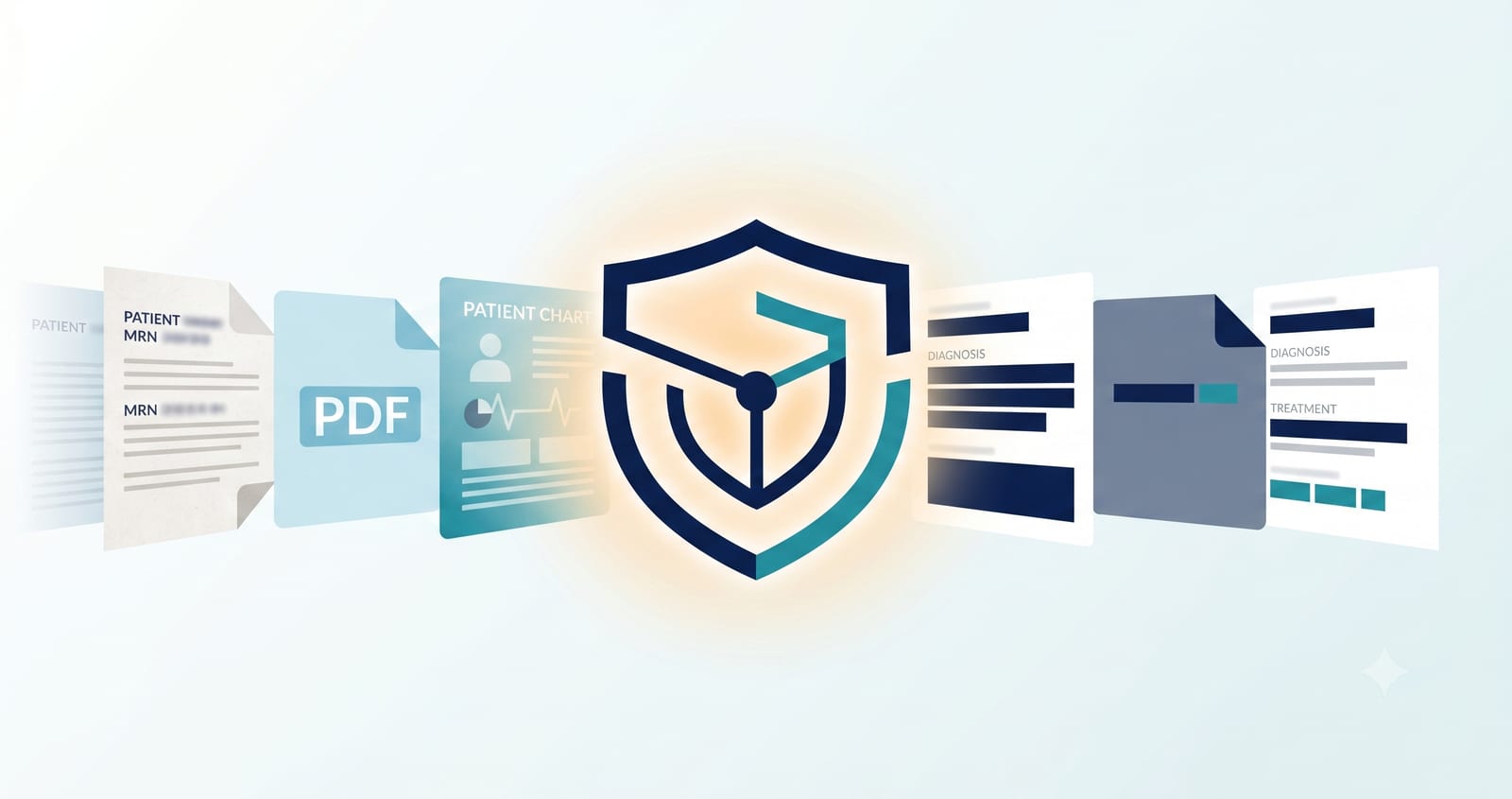
Healthcare has entered its AI decade.
Every team wants to use AI on clinical notes, claims documents, scanned PDFs, discharge summaries, prior authorization packets, coding charts, audit files, and operational workflows. But one question stops most serious healthcare AI adoption before it starts:
Can we use AI without exposing PHI, personal identifiers, or sensitive patient information?
That question is exactly why we built DelPHI — De-Identify & Label PHI — a privacy-first de-identification tool from Jivica AI, now open for beta access.
DelPHI helps teams remove, mask, or label Protected Health Information (PHI) and personal identifiers from documents before those documents are used in AI, analytics, coding, QA, audit, or automation workflows.
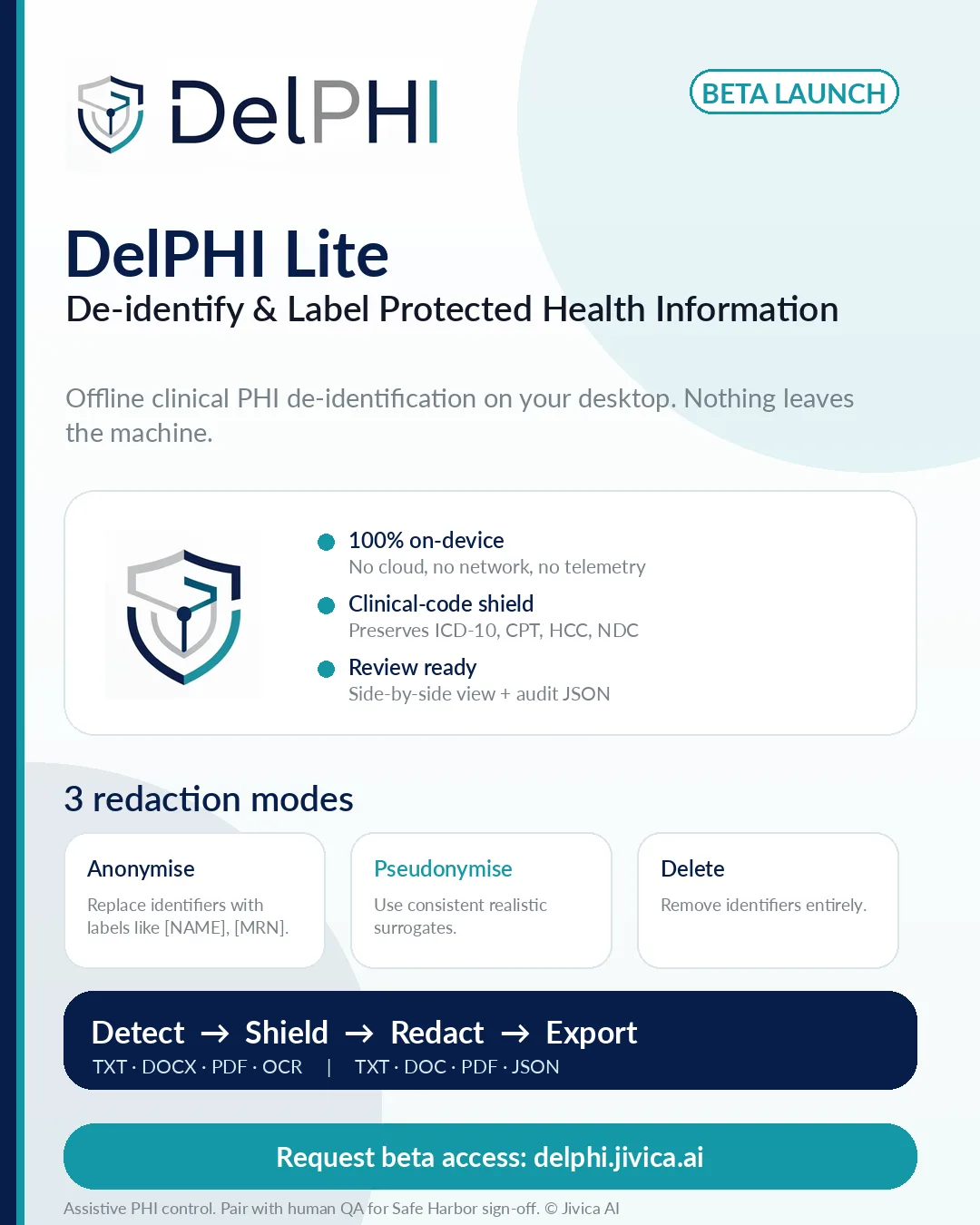
Beta access is now live. Try DelPHI on the web at delphi.anica.live, or download DelPHI Lite for fully offline, on-device de-identification on Windows. You can request access and learn more at delphi.jivica.ai or on the DelPHI product page.
Why DelPHI, and why now?
AI is no longer a slide-deck experiment in healthcare. It is already entering medical coding, risk adjustment, RCM, clinical summarization, chart review, payer operations, claims analytics, prior authorization, quality review, and patient engagement.
But healthcare data is not ordinary enterprise data. A clinical chart can contain names, dates, phone numbers, addresses, medical record numbers, claim identifiers, provider references, insurance details, signatures, and free-text clues that can reveal a person's identity. A single unredacted document passed into the wrong AI workflow can create compliance, contractual, legal, reputational, and ethical risk.
The risk is not theoretical.
- The U.S. Department of Health and Human Services provides formal guidance on HIPAA de-identification, including the Safe Harbor and Expert Determination methods.
- HIPAA Safe Harbor requires removal of 18 categories of identifiers relating to the individual or relatives, employers, or household members.
- IBM's 2025 Cost of a Data Breach report puts the global average breach cost at $4.44 million — and found that ungoverned "shadow AI" added an extra $670,000 to the average breach.
- Healthcare remained the most expensive industry for the 14th consecutive year, at $7.42 million per breach.
- The Change Healthcare cyberattack affected approximately 192.7 million people, making it one of the most consequential healthcare data incidents in U.S. history.
- India's Digital Personal Data Protection Act, 2023 and Europe's GDPR reinforce the same direction of travel: sensitive personal data must be processed with purpose, care, governance, and accountability.
The message is clear: healthcare teams want AI, but they cannot afford careless exposure of PHI. For a deeper technical treatment, see our guide to HIPAA-compliant de-identification.
DelPHI exists to make safer AI workflows practical.
The positioning: DelPHI is not just a redaction tool
A simple redaction tool hides text.
DelPHI is designed to become something more strategic:
DelPHI is the privacy gateway that lets healthcare teams use AI safely on sensitive documents.
That distinction matters.
Most healthcare AI workflows do not begin with clean APIs and perfectly structured FHIR records. They begin with messy reality:
- scanned PDFs,
- physician notes,
- discharge summaries,
- lab reports,
- claim packets,
- medical coding charts,
- chart audit files,
- mixed digital and OCR documents,
- exported EHR documents,
- RCM work queues,
- payer/provider correspondence,
- and free-text clinical narratives.
These files often contain high-value clinical context mixed with high-risk identifiers.
The goal is not merely to black out words. The goal is to preserve useful clinical and business context while reducing identity exposure.
That is the hard part.
What DelPHI does
DelPHI helps identify and remove or label PHI and personal identifiers from unstructured documents.
It is built for teams that need to work with sensitive healthcare data but want to reduce exposure before using that data with AI systems, human reviewers, analytics teams, or downstream automation.
Core capabilities in beta
- PHI and PII detection across clinical and business documents
- Document and PDF support for healthcare workflows
- Cloud mode for fast access and evaluation
- Offline mode for local processing where documents should not leave the machine
- Clinical-context preservation so de-identification does not destroy the usefulness of the document
- Identifier labeling and review for transparency and auditability
- Workflow fit for AI, coding, RCM, compliance, and data operations teams
The beta is meant to validate real-world use cases, stress-test document variety, and learn where de-identification must become more precise, more configurable, and more enterprise-ready.
The problem with "just upload it to AI"
The temptation is obvious: take a chart, upload it to a model, ask for a summary, coding suggestions, quality gaps, claim insights, or patient risk analysis.
But the real world adds complications:
- Who is the data processor?
- Is PHI being sent to a third-party AI system?
- Is the data stored, logged, retained, or used for model improvement?
- Does the organization have a BAA, DPA, or equivalent contractual protection?
- Is the workflow compliant with HIPAA, DPDP, GDPR, or customer-specific obligations?
- Can the company prove what was removed and what remained?
- Can clinical context survive de-identification?
For early experiments, these questions may be ignored.
For real healthcare operations, they cannot be.
DelPHI is built around a simple belief:
Before sensitive documents go into AI, they should pass through a privacy layer.
Who should try DelPHI Beta?
DelPHI is especially relevant for teams working with healthcare documents, regulated personal data, or AI workflows involving sensitive text.
1. RCM and medical coding companies
RCM teams handle large volumes of charts, claims, denials, audit packets, and coding documentation. These documents are rich in PHI and operationally valuable.
DelPHI can help RCM teams prepare documents for:
- AI-assisted medical coding,
- HCC and risk-adjustment review,
- coding audit,
- denial analysis,
- QA workflows,
- training and benchmarking,
- offshore/onshore review workflows,
- and internal automation.
The use case is simple: remove identity risk before documents enter AI-assisted review. This pairs naturally with capturing strong MEAT evidence in coding workflows.
2. Healthcare AI startups
Every healthcare AI startup faces the same trust barrier:
"Can we let your system process our data safely?"
DelPHI can help healthcare AI startups de-identify documents before model processing, demos, testing, analytics, or internal evaluation.
This is especially relevant for startups building:
- clinical summarization tools,
- coding copilots,
- chart review agents,
- payer/provider automation,
- patient document intelligence,
- prior authorization systems,
- claims intelligence,
- clinical trial screening,
- and healthcare operations copilots.
A strong de-identification layer can make pilots easier to approve and safer to run.
3. Hospitals, clinics, and provider groups
Hospitals and clinics want AI, but they often face internal governance barriers around PHI exposure.
DelPHI can support teams that want to experiment with AI on documents while reducing exposure of patient identifiers.
Examples:
- anonymized chart review,
- internal QA,
- clinical note analysis,
- operational analytics,
- provider documentation improvement,
- and AI-readiness workflows.
For provider teams, offline or private deployment can be especially important.
4. Payers, TPAs, and insurance operations
Payer and insurance teams work with claims, policyholder information, medical records, prior authorization files, appeal letters, and provider correspondence.
DelPHI can help reduce identity exposure before documents are routed into AI systems for:
- claims analytics,
- utilization review support,
- fraud/waste/abuse review,
- policy operations,
- prior authorization intelligence,
- and payer-provider workflow automation.
5. Compliance, privacy, and data governance teams
Privacy teams are often asked to approve AI experiments after the product or analytics team has already started moving fast.
DelPHI can help shift the conversation from "No, we cannot use this data" to "Here is a safer path to evaluate this data."
The goal is not to bypass governance. The goal is to operationalize it.
6. Research, analytics, and data science teams
Healthcare data science teams need useful datasets, but raw identifiers can block research, prototyping, and model evaluation.
DelPHI can help create de-identified or pseudonymized working copies of documents for controlled downstream use.
Important caveat: de-identification is not magic. It reduces risk; it does not eliminate every possible re-identification risk in every context. That is why DelPHI should be part of a broader privacy, security, and governance architecture.
Cloud and offline: why both matter
Healthcare is not one market. Deployment preferences vary sharply by customer type, geography, contract, and risk appetite.
That is why DelPHI Beta is available in both cloud and offline modes: DelPHI on the web at delphi.anica.live for cloud evaluation, and DelPHI Lite, a downloadable Windows app, for fully offline processing where nothing leaves the machine.
Cloud mode
Available now as a web app at delphi.anica.live.
Cloud mode is useful for:
- quick evaluation,
- low-friction beta testing,
- small files,
- early demos,
- feature validation,
- and teams that are comfortable testing with non-sensitive or synthetic documents.
Offline mode
Available now as DelPHI Lite, a Windows desktop download.
Offline mode is useful when:
- documents should not leave the local machine,
- internet access is constrained,
- internal policy blocks cloud upload,
- a team wants to evaluate with representative files,
- or a customer prefers local/private workflows before enterprise deployment.
For many healthcare buyers, offline is not a feature; it is a trust signal.
From the beta. One early user wanted to be certain that nothing left their network. So they physically disconnected the machine from the internet and ran DelPHI Lite air-gapped. Every document processed normally — full de-identification, no errors, no missing features, zero network dependency. For teams where "nothing leaves the perimeter" is a hard requirement, that result is the entire point.
What makes healthcare de-identification hard?
Healthcare de-identification is harder than generic PII removal because clinical meaning matters.
A naive system may remove too much and destroy the value of the document. A weak system may remove too little and leave identifiers behind.
A good healthcare de-identification workflow must balance both sides:
| Risk | What happens |
|---|---|
| Under-redaction | PHI or personal identifiers remain exposed |
| Over-redaction | Clinical meaning, coding evidence, or audit context is damaged |
| Inconsistent redaction | Downstream review becomes unreliable |
| No audit trail | Compliance and QA teams cannot inspect what happened |
| No deployment flexibility | Customers cannot use the system in their real environment |
DelPHI is being built with this balance in mind: remove what should not be exposed, preserve what the workflow still needs.
A realistic view: de-identification is necessary, but not sufficient
We should be honest about the category.
De-identification is a critical privacy control, but it is not a silver bullet. Modern AI and data-linkage techniques raise new questions around quasi-identifiers, contextual clues, and re-identification risk. Recent research has also argued that traditional Safe Harbor-style de-identification may be insufficient in the age of large language models, especially for rich clinical narratives.
That does not make de-identification irrelevant.
It makes it more important to do it well, document it clearly, and combine it with other controls:
- access control,
- encryption,
- private deployment,
- contractual safeguards,
- audit logs,
- human review,
- data minimization,
- retention limits,
- and model governance.
DelPHI is designed to be one practical layer in that responsible AI stack.
What beta users should test
If you are joining the DelPHI Beta, we would love feedback on real workflows, not just synthetic examples.
Please try DelPHI with 2–3 representative documents and evaluate:
- Detection — Did it find the identifiers you expected?
- Misses — What PHI or personal data remained?
- Over-redaction — Did it remove useful clinical or business context?
- Output usability — Could the de-identified output still be used for AI, coding, audit, or analytics?
- Deployment fit — Would your team prefer cloud, offline, private cloud, or on-prem?
- Volume — Is this a one-off need, a team workflow, or a high-volume operational process?
- Trust — What would your organization need before using this in production?
The most valuable feedback is not only "this worked" or "this failed."
The most valuable feedback is:
"Here is the workflow we want to unlock once the document is safely de-identified."
That tells us what DelPHI should become.
Example workflows DelPHI can unlock
Workflow 1: AI-assisted medical coding
A coding team wants to use AI to extract diagnoses, MEAT evidence, HCCs, or E/M suggestions from charts.
Before sending documents into an AI coding pipeline, DelPHI can remove direct identifiers and preserve the clinical evidence needed for coding review.
Workflow 2: RCM denial analysis
An RCM team wants to analyze denial letters, claim packets, and appeal documents.
DelPHI can help strip personal identifiers before the documents are routed into AI summarization, classification, or analytics tools.
Workflow 3: Healthcare AI startup demos
A startup wants to show how its AI works on realistic healthcare documents, but customers do not want raw PHI in demo datasets.
DelPHI can help create safer demonstration and evaluation files.
Workflow 4: Internal compliance review
A compliance team wants to inspect whether teams are sharing sensitive documents into AI tools.
DelPHI can become a pre-processing step before approved AI usage.
Workflow 5: Data science and research preparation
A research team needs working copies of clinical narratives for NLP, cohort discovery, or analytics.
DelPHI can help prepare de-identified versions for controlled downstream use.
Workflow 6: Offshore/onshore operations
A healthcare operations company needs to distribute documents across teams, vendors, or geographies.
DelPHI can reduce identifier exposure before documents move across operational boundaries.
Why this matters for Jivica AI
At Jivica AI, our broader mission is to build practical, privacy-first AI for healthcare operations.
DelPHI is part of that mission.
We are also building healthcare AI systems for coding, audit, risk adjustment, RCM, and clinical document intelligence. But no serious healthcare AI stack can ignore privacy.
DelPHI is the layer that says:
AI should not require reckless data exposure.
The future of healthcare AI will not be won only by the most powerful models. It will be won by systems that are accurate, useful, auditable, deployable, and trustworthy.
A note from the founder
"We built DelPHI because healthcare teams should not have to choose between using AI and protecting sensitive patient information. The next wave of healthcare AI needs privacy built into the workflow, not added as an afterthought." — Anand P. Mandala, Founder, Jivica AI
Join the beta
DelPHI Beta is now open.
If you work in healthcare, AI, RCM, medical coding, compliance, insurance, data privacy, clinical operations, or analytics, we would love for you to try it and share feedback.
Try DelPHI on the web at delphi.anica.live, or request beta access and download DelPHI Lite (offline, Windows) at delphi.jivica.ai.
If DelPHI is relevant to your organization, we are especially interested in speaking with teams evaluating:
- offline de-identification,
- private deployment,
- high-volume document processing,
- AI-safe preprocessing,
- medical coding and RCM workflows,
- and enterprise compliance requirements.
Your feedback will shape the product.
References and further reading
- U.S. HHS — Guidance Regarding Methods for De-identification of Protected Health Information in Accordance with the HIPAA Privacy Rule: https://www.hhs.gov/hipaa/for-professionals/special-topics/de-identification/index.html
- U.S. HHS OCR Breach Portal: https://ocrportal.hhs.gov/ocr/breach/breach_report.jsf
- IBM — Cost of a Data Breach Report 2025: https://www.ibm.com/reports/data-breach
- Reuters — Change Healthcare breach impact reported at approximately 192.7 million people: https://www.reuters.com/business/hack-unitedhealths-tech-unit-impacted-1927-million-people-us-health-dept-website-2025-08-14/
- Government of India / MeitY — Digital Personal Data Protection Act, 2023: https://www.meity.gov.in/static/uploads/2024/06/2bf1f0e9f04e6fb4f8fef35e82c42aa5.pdf
- EUR-Lex — Regulation (EU) 2016/679, General Data Protection Regulation: https://eur-lex.europa.eu/eli/reg/2016/679/oj/eng
- McKinsey — The State of AI: Global Survey 2025: https://www.mckinsey.com/capabilities/quantumblack/our-insights/the-state-of-ai
- Jiang, Liu, Cho, Oermann — "Paradox of De-identification: A Critique of HIPAA Safe Harbour in the Age of LLMs" (2026): https://arxiv.org/abs/2602.08997
- Khan, Menten, Peeters — "An Algorithmic Pipeline for GDPR-Compliant Healthcare Data Anonymisation" (2025): https://arxiv.org/abs/2506.02942
Disclaimer
DelPHI Beta is an early-access product. De-identification reduces privacy risk but does not guarantee that every document is fully anonymized or free from re-identification risk in every context. Users should validate outputs before production use and consult their legal, compliance, privacy, and security teams for obligations under HIPAA, DPDP, GDPR, contractual requirements, and other applicable laws or regulations.